
There is no denying that running is definitely one of the most popular fitness activities in Guernsey.
However, as runners start to increase their mileage the chance of injury also goes up, especially if you have underlying muscle imbalances.
I train a lot of runners from helping our Olympian Lee Merrien to the weekend warrior who has set themselves a target of an easter 10K, Fathers day half marathon through to a full marathon.
The purpose of this article is to explore the more common running injuries and provide you with tips to help prevent them from happening.
Common running related injuries include
- Patellofemoral pain syndrome
- IT Band syndrome
- Shin splints
- Plantar fasciitis

STOP GUESSING AND START ASSESSING!
One of the first things you can do to help identify potential injuries is to complete a movement assessment. Two of my favourite to use with runners include an Overhead Squat and Single Leg Squat.
Completing a movement assessment will help identify potential risk factors for injuries and corrective strategies to apply to help prevent an injury occurring.
Key identifying factors that could mean you are predisposed to a running related injury include:
- Knees that move inwards
- Feet that flatten
Far too often people jump straight in to a running program without considering how muscle imbalances and weak muscles around the hips and core can be determining factors in a running specific injury.
Letʼs take a look at the big 4 common related running injuries……….

PATELLOFEMORAL PAIN SYNDROME
PFPS occurs due to a variety of causes ranging from overuse to direct trauma. Runners suffering from PFPS will typically complain of pain when going down stairs or squatting, even driving or sitting for long periods can cause pain.
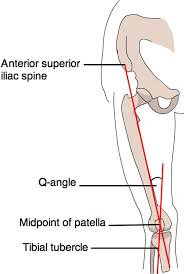
PFPS is more common in female runners due to the effects of something called the Q angle, which is typically associated with anterior knee pain of PFPS.
The increased Q angle at the hips which also leads to the knees caving in. These two contributing factors lead to abnormal lateral tracking of the patella and increased loading on the inside of the knee.
This is a structural impediment that cannot be corrected a larger Q angle is something that some women are born with.
The best way to address PFPS is to address hamstring tightness, particular the bicep femoris, tensor fascia latae (TFL) and a calf muscle called the gastrocnemius. You should also strengthen the muscles around your hips (glute medius and glute maximus) your VMO (the small tear drop shaped muscle on the inside of your knee) and lower abdominal and oblique core muscles.
WHAT IS THE Q ANGLE?
The Q angle of the knee is a measurement of the angle between the quadriceps muscles and the patella tendon and provides useful information about the alignment of the knee joint.
IT BAND SYNDROME
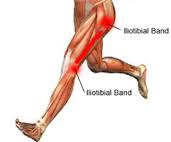
The IT band is the ligament that runs on the outside of your thigh from your hip to the tibia, a bone just under your knee camp. It can become inflamed and irritated as it rubs against a bony landmark on your thigh bone on the outside of your leg just above your knee. Quite often this pain is called RUNNERS KNEE.
It is an overuse injury most commonly experienced by long distance runners, cyclists and triathletes. It is normally associated with an increase in training volume and/or abnormal running mechanics.
Research has indicated that it is normally caused by weakness in your glute medius and glute maximus with tightness in your TFL, Quads and weakness in the hamstrings compared to Glute strength.

SHIN SPLINTS
Along with IT band syndrome this is probably the most common running related injury I see. The clinical name for Shin splints is tibial stress syndrome and it is an overuse injury typically associated with beginner runners but also more experienced runners when they increase their running volume or even their running surface.
Unfortunately there is not too much that can be done for this type of injury as it is typically caused by running too much too soon. However, studies have shown that risk factors for shin splints include overpronation (flattening of your foot) and increased movement around the ankle joint. Exercises that can help prevent shin splints are strengthen exercises for your posterior and anterior tibialis as well as hip strengthening exercises for your hips.

PLANTAR FASCIITIS
The platnar fascia is a piece of connective tissue that runs along the bottom of your foot, from the calcaneos (bottom of your ankle) to the metatarsals (knuckles on the bottom of your foot at the front by the start of the toes and along the arch of your foot in a triangular shape.
It normally occurs when this tissue becomes inflammed and irritated. It is a common cause of heel pain especially first thing in the morning when you get out of bed.
Flat feet and a lack of ankle mobility have been associated with Plantar fasciitis as well as a high BMI.
Corrective exercise strategies for this focus on stretching the gastrocnemius (a calf muscle) and hamstrings.
Whist most of these injuries can be addressed with rest, reduced mileage and cross training, preventing them is a better approach.
By seeking professional advice and completing a series of movement assessments your potential risk factors for injury can be identified for running injuries allowing corrective strategies to be implemented before an injury occurs.